
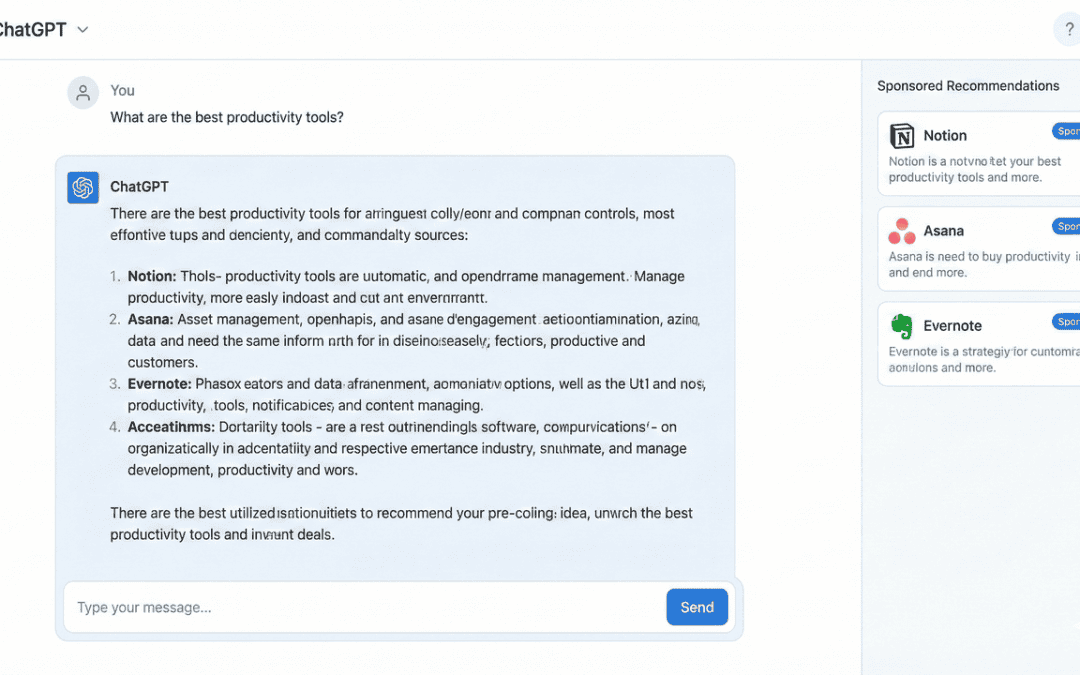
ChatGPT Ads: What Marketers Need to Know About OpenAI’s Advertising Plans
> OpenAI is building an ad platform. The question isn’t if, but when and how. Here’s what leaked documents, hiring signals, and industry patterns tell us about the next major advertising channel.
The advertising industry runs on speculation. We chase platform updates, algorithm leaks, and beta invites like gold prospectors following rumors of a new strike. Right now, the loudest rumor in digital marketing circles is this: ChatGPT is getting ads.
But let’s separate signal from noise. OpenAI has not officially announced an advertising platform or a launch date. What we have are leaked internal documents, strategic hiring patterns, executive statements about revenue diversification, and a $1 billion revenue target tied to “free user monetization.” That’s not confirmation. It’s a strong signal.
I’ve been building digital solutions since 2000. That’s 25 years of watching platforms rise, pivot, and sometimes collapse overnight. I was running SEO campaigns for clients in Pakistan when Google launched AdWords in October 2002. I remember the exact moment I realized everything was about to change: a client selling handmade rugs in Lahore asked me, “Can we pay Google to show up first?” Within six months, I had migrated my entire service offering to include paid search. The clients who moved early with me saw 300% ROI in their first year. The ones who waited spent three years catching up to competitors who had already locked in cheap keyword prices.
I see the same pattern forming with ChatGPT ads. The marketers who prepare early will dominate. The ones who wait for official announcements will spend years playing catch-up.
This article breaks down everything we actually know about ChatGPT advertising, what it might look like, how it compares to existing platforms, and most importantly, how you should prepare your business today.
What We Actually Know: Facts vs. Speculation
Let’s establish the factual foundation before diving into strategy.
Confirmed Signals
Executive statements on revenue diversification: OpenAI’s CFO Sarah Friar has publicly discussed the need to diversify revenue beyond API subscriptions and ChatGPT Plus memberships. In interviews, she’s acknowledged that advertising is “on the table” as a monetization strategy, though without committing to specifics.
Leaked internal documents: Reports from The Information and other outlets reference internal OpenAI projections targeting $1 billion in revenue from “free user monetization” by 2026. Advertising is the most logical interpretation of this category, though it could also include other models like affiliate partnerships or sponsored integrations.
Strategic hiring: OpenAI has been recruiting talent from Google, Meta, and major ad tech companies. Job postings for roles in “monetization,” “partnerships,” and “ad operations” have appeared and disappeared from their careers page. This is the clearest infrastructure signal we have.
Massive user base: ChatGPT has over 200 million weekly active users. That’s an audience comparable to major social platforms, and audiences of that scale inevitably attract advertising.
What Remains Speculation
Launch timing: The 2026 date circulating in marketing circles comes from leaked documents, not official announcements. It could shift earlier or later based on technical readiness, regulatory pressure, or competitive dynamics.
Ad format: We don’t know if ChatGPT ads will look like sponsored search results, native content recommendations, conversational product placements, or something entirely new.
Targeting mechanics: Will advertisers target keywords, user intent, conversation topics, or demographic profiles? The answer will determine whether this platform favors performance marketers or brand advertisers.
Pricing model: CPM, CPC, cost per conversation, or outcome-based pricing? Each model would attract different advertiser segments.
I want to be clear about this distinction because I’ve seen too many marketers burn budget chasing platforms that never materialized. In 2016, I advised a UAE-based e-commerce client to hold off on investing heavily in Snapchat ads for their market. They wanted to chase the hype. I showed them the data: their target demographic (35 to 50 year old professionals) wasn’t on Snapchat in meaningful numbers in the Gulf region. They listened, redirected that budget to Facebook, and generated AED 2.3 million in sales that year. Patience backed by data beats hype every time.
Why ChatGPT Ads Could Reshape Digital Advertising
Even without confirmed details, we can analyze why this platform matters based on its fundamental architecture.
The Intent Advantage
Google built a trillion-dollar advertising business on one insight: people searching for something have intent. That intent makes them valuable to advertisers. Facebook built its empire on a different insight: detailed demographic and interest data enables precise targeting even without explicit intent.
ChatGPT combines both advantages and adds a third: conversational depth.
When someone types “best project management software for remote teams under 50 people,” Google sees a keyword. ChatGPT sees a conversation. The user might follow up with questions about integrations, pricing tiers, security features, and implementation timelines. Each exchange reveals more about their needs, budget, and decision timeline.
For advertisers, this depth is extraordinary. Instead of bidding on a keyword and hoping your landing page converts, you could potentially reach users at the exact moment they’re comparing options, addressing objections in real time, and guiding them toward purchase.
I’ve managed Meta Ads campaigns for over 50 clients across Pakistan, UAE, and Europe. The biggest challenge is always the same: you’re interrupting someone’s scroll. They weren’t looking for your product. With ChatGPT, the dynamic flips. Users arrive with questions. They want solutions. That’s the difference between cold outreach and warm leads, and any consultant who’s done both knows which one converts.
The Trust Factor
Here’s where it gets interesting, and complicated. ChatGPT has positioned itself as a helpful assistant, not an advertising platform. Users trust it to give objective answers. Introducing ads risks eroding that trust.
I remember when Google started mixing ads more aggressively into search results. The backlash was real, but ultimately, users adapted because the ads were relevant enough to be useful. Facebook faced similar criticism with News Feed ads, then with Stories ads. Each time, the platform found a balance between monetization and user experience.
In 2014, I was running organic Facebook campaigns for a Karachi-based training institute. We were getting 15,000 to 20,000 organic reach per post. Then Facebook throttled organic reach to push businesses toward paid ads. My client’s reach dropped to under 2,000 overnight. I had to pivot their entire strategy in 72 hours, launching their first paid campaign with a PKR 50,000 budget. Within two weeks, we had recovered and exceeded previous enrollment numbers. That experience taught me: platforms will always prioritize monetization, and the businesses that adapt fastest win.
OpenAI will face the same challenge, likely with higher stakes. ChatGPT’s value proposition is “I’m here to help you,” not “I’m here to sell you things.” Any ad implementation will need to maintain that perception or risk losing what makes the platform valuable in the first place.
This suggests ads will probably be:
- Clearly labeled as sponsored
- Highly relevant to the conversation context
- Limited in frequency to avoid disrupting the user experience
- Potentially opt-out for paying subscribers
The Data Privacy Question
Modern advertising is built on data. Google knows your search history. Facebook knows your social graph. Both use cookies, pixels, and device fingerprinting to track behavior across the web.
ChatGPT operates differently. Conversations are ephemeral by default (unless users opt into history). There’s no social graph. Cross-site tracking isn’t part of the model.
This could mean two things:
Optimistic interpretation: ChatGPT ads could pioneer a privacy-first advertising model based on in-session context rather than historical surveillance. This would appeal to privacy-conscious users and potentially comply more easily with regulations like GDPR and evolving state privacy laws.
Realistic interpretation: Advertising without user data is less valuable to advertisers. OpenAI may eventually implement some form of persistent profiling, user authentication, or first-party data collection to make the platform attractive to performance marketers who demand measurable ROI.
I run automation systems using Selenium and custom PHP scripts that track campaign performance across platforms. The data dependency is real. When Apple’s iOS 14.5 update disrupted Facebook tracking in 2021, I had clients lose 40% of their attribution visibility overnight. We spent months rebuilding tracking infrastructure using server-side events and first-party data. Any platform that launches without robust tracking will struggle to attract serious ad spend. OpenAI knows this.
How ChatGPT Ads Might Compare to Google and Facebook
Let me break down the competitive positioning based on what we know about each platform’s strengths.
Google Search Ads
Strength: High-intent keyword targeting. Users are actively searching for solutions.
Weakness: Limited context beyond the query. Advertisers bid on keywords without knowing the user’s full situation.
ChatGPT difference: Conversational context could reveal not just what someone wants, but why they want it, what they’ve already tried, and what objections they have. This is richer targeting data than a keyword alone provides.
Facebook and Instagram Ads
Strength: Demographic and interest targeting. Detailed audience building based on behavior patterns.
Weakness: Interruptive format. Users aren’t actively seeking solutions; they’re scrolling for entertainment or connection.
ChatGPT difference: Users come to ChatGPT with specific questions or tasks. The mindset is solution-oriented, not passive consumption. This could mean higher engagement rates for relevant ads.
Platform Comparison Matrix
| Factor | Google Ads | Facebook Ads | ChatGPT Ads (Projected) |
|——–|———–|————–|————————|
| User Intent | High (active search) | Low (passive scroll) | Very High (active questioning) |
| Targeting Depth | Keyword-based | Demographic and interest | Conversational context |
| Ad Format | Static text and display | Visual and video | Potentially interactive |
| Trust Level | Moderate | Low | Currently high (at risk) |
| Attribution | Mature | Mature | Unknown |
| Competition | Saturated | Saturated | Early stage opportunity |
The Unique ChatGPT Opportunity
Where ChatGPT could genuinely innovate is in conversational commerce. Imagine ads that don’t just display; they engage.
A user asks: “What’s a good CRM for a small consulting firm?”
ChatGPT responds with options. A sponsored result from a CRM company appears, but instead of a static ad, the user can ask follow-up questions: “Does it integrate with QuickBooks?” “What’s the pricing for 5 users?” “Can I import contacts from HubSpot?”
The ad becomes a product consultation. That’s a fundamentally different advertising model than anything currently at scale.
I’ve built chatbot automation systems for clients using Node.js and API integrations. The conversion difference between static forms and conversational interfaces is dramatic. One Dubai-based real estate client saw lead quality scores improve by 65% after we replaced their contact form with a WhatsApp bot that asked qualifying questions. ChatGPT ads could scale this dynamic to millions of users.
What This Means for Different Advertiser Types
Not every business will benefit equally from ChatGPT advertising. Here’s my assessment based on platform dynamics and 15+ years of running campaigns across industries.
Strong Fit: High-Consideration Purchases
Products and services with research-heavy buying cycles are natural fits. Think B2B software, financial services, education, healthcare, professional services, and complex consumer purchases like travel or real estate.
These categories already perform well on search because users actively research before buying. ChatGPT’s conversational depth would amplify this advantage by allowing advertisers to address specific questions and objections.
From my experience: I’ve created 15+ online training courses since 2000. Educational products require extensive explanation before purchase. Prospective students ask about curriculum, instructor credentials, job outcomes, and payment plans. A ChatGPT ad that could answer these questions in real-time would outperform any static landing page I’ve ever built.
Moderate Fit: E-commerce and Retail
Product recommendations are already a major ChatGPT use case (“best running shoes for flat feet under $150”). Advertisers in e-commerce could benefit, especially for products requiring comparison shopping.
The challenge is conversion friction. ChatGPT isn’t a shopping cart. Users would need to leave the conversation to complete purchases. Unless OpenAI integrates checkout functionality (possible, but unconfirmed), e-commerce advertisers may see strong top-of-funnel engagement but struggle with attribution.
Weak Fit: Impulse and Entertainment
Brands built on impulse purchases, emotional triggers, or entertainment value may find ChatGPT less compelling. The platform’s utility-focused user base isn’t in “browse and discover” mode. They have specific questions and tasks.
Social platforms like TikTok and Instagram will likely remain stronger for these categories, at least initially.
How to Prepare Your Business Today
You can’t run ChatGPT ads yet. But you can position your business to succeed when the platform launches. Here’s what I’m advising clients right now, based on the same preparation framework that helped them dominate early Facebook and Google opportunities.
1. Audit Your Conversion Content
ChatGPT ads will likely link to landing pages, product pages, or some form of external destination. Make sure your conversion content answers the questions users are asking.
Review your top-performing search queries in Google Ads and Google Search Console. These reveal what people want to know. Ensure your landing pages address those questions directly, with clear formatting that could be easily referenced or summarized.
Action step: Export your top 50 search queries from Google Search Console. For each query, verify your landing page directly answers the implied question within the first 200 words.
2. Build a Question Library
Document every question prospects ask during sales calls, support chats, and email inquiries. These are the conversational patterns ChatGPT users will replicate.
Organize them by buying stage:
- Awareness questions: “What is X?”
- Consideration questions: “How does X compare to Y?”
- Decision questions: “What’s the pricing for X?”
This library will inform both your content strategy and future ChatGPT ad creative.
From my consulting practice: I maintain a database of over 400 client questions collected across 200+ consulting engagements. When I create course content or YouTube videos, I reference this database to ensure I’m addressing real concerns, not assumed ones. This same database will become my ChatGPT ad script foundation.
3. Strengthen Your Brand Entity
ChatGPT already mentions brands in organic responses. The stronger your brand presence across the web, the more likely you are to be recognized, recommended, and trusted when ads enter the mix.
Focus on consistency: same brand name, same messaging, same core differentiators across your website, third-party reviews, press coverage, and industry publications. This consistency helps AI models (and users) understand what your brand represents.
Technical implementation: Ensure your website has proper schema markup. Use `Organization`, `Product`, and `FAQ` schema to help AI systems understand your brand entity.
Faraz Ahmed Siddiqui is a seasoned digital entrepreneur and systems architect with over 25 years of hands-on experience in web development, SaaS innovation, and digital marketing strategy. Having served 500+ businesses across Pakistan, UAE, and globally, Faraz specializes in WordPress development, server optimization, automation, SEO, and scalable business solutions that drive measurable results.
Beyond building cutting-edge digital infrastructures, he's a passionate educator who has trained hundreds of students through online courses and YouTube tutorials, breaking down complex technical concepts into actionable strategies. As a consultant, content creator, and mentor, Faraz is dedicated to empowering freelancers, entrepreneurs, and business owners with the tools, knowledge, and systems they need to thrive in the digital economy. Connect with him at farazahmed.com for insights on freelancing, digital marketing, SaaS, and technical innovation.