
Introduction
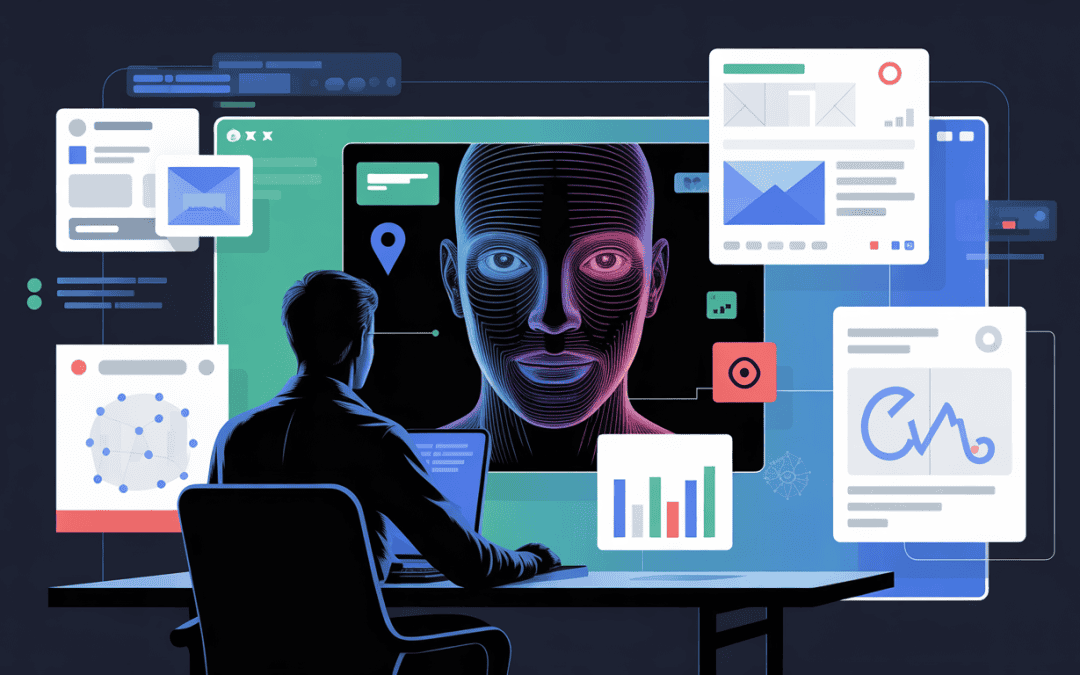
There’s a seductive pitch making the rounds in Silicon Valley: AI that knows you better than you know yourself. Google’s leadership, including Search VP Robby Stein, has been articulating a vision where Gemini doesn’t just answer your questions—it answers them for you specifically, drawing on your emails, your documents, your photos, your location history, and your browsing patterns to deliver uniquely tailored recommendations.On the surface, this sounds like the natural evolution of helpful technology. Who wouldn’t want an assistant that remembers your preferences, understands your schedule, and anticipates your needs?But here’s the question I keep coming back to after two decades of building web infrastructure, SaaS platforms, and digital systems: When does “AI that knows you” become “AI that watches you”?My thesis is straightforward: personalization at this depth isn’t just a UX enhancement. It’s a major security and privacy event that concentrates risk in ways we haven’t fully grappled with as an industry. The same architectural decisions that make Gemini “uniquely helpful” also make it uniquely dangerous if mismanaged, breached, or quietly repurposed.Let me explain why—and what we can actually do about it.What Google Is Building: The New AI Personalization Stack
To understand the stakes, we first need to understand what Google is actually constructing.This isn’t about smarter autocomplete or better search rankings. Google is building what I’d call a cross-service data fusion layer—a unified AI context system that can reach into:- Gmail: Your personal and professional correspondence, receipts, confirmations, and conversations.
- Google Calendar: Your schedule, appointments, and time commitments.
- Google Drive: Your documents, spreadsheets, presentations—potentially including sensitive business materials.
- Google Photos: Your images, including faces, locations, and timestamps embedded in metadata.
- Maps Timeline and Location History: Where you go, how often, and when.
- Search and Browsing History: What you’re curious about, what you’re researching, what you’re worried about.
The convenience is real. But so is the concentration of intimate data into a single, AI-accessible context layer.This is not your grandfather’s search engine. This is a system designed to build and maintain a rich, persistent model of you—and to use that model every time you interact with it.
From Convenience to Attack Surface: A Security Analyst’s View
I’ve spent my career building systems, and one principle has proven itself over and over again: every new layer of integration creates a new attack surface and a new single point of failure.When you stitch together email, documents, photos, location data, and browsing history into a unified AI context, you’re not just adding features. You’re creating something that didn’t exist before: a fused, queryable representation of a person’s entire digital existence.From a security perspective, this changes everything.Expanded Attack Surface and Single Point of Failure
Let’s be concrete about what an attacker could gain if Gemini’s personalized context layer—or the systems feeding into it—were compromised:- Private communications: Not just recent emails, but potentially years of correspondence across personal and professional contexts.
- Sensitive documents: Contracts, financial statements, strategic plans, medical records—whatever lives in your Drive.
- Location patterns: Where you live, where you work, where you travel, when you’re away from home.
- Behavioral fingerprints: Your search history reveals what you’re thinking about, what you’re worried about, what you’re planning.
Human Review and Insider Risk
Google has disclosed that “human reviewers may read some of their data” when users interact with these AI features. In the context of a simple search query, this might seem innocuous.In the context of deeply personalized AI that fuses your emails, documents, and location history? The implications are far more serious.Consider what a human reviewer might see:- Email threads discussing health conditions, legal matters, or family disputes.
- Documents containing proprietary business information or client data.
- Location patterns that reveal sensitive activities or associations.
- Search queries that expose private concerns, beliefs, or interests.
- How many reviewers have access to personalized data?
- What vetting, monitoring, and auditing do they undergo?
- Which data slices and which geographies can they access?
- Are there technical controls preventing reviewers from querying specific individuals?
Training Data Attacks and Model Misuse
Model Inversion: Attackers may attempt to reconstruct sensitive information that was implicitly learned during model training or personalization. If a model has been fine-tuned on your data, certain prompts might reveal patterns or details that were never meant to be exposed.Membership Inference: Sophisticated attackers can sometimes determine whether a specific document, email, or data point was included in training data. For high-value targets, this alone can be a significant intelligence leak.Prompt Injection and Data Exfiltration: Malicious websites, emails, or documents could contain hidden instructions designed to trick Gemini into leaking private context or taking unintended actions. As AI systems gain more access to personal data, the incentive to develop these attacks increases.Personalization doesn’t just increase the value of the target—it increases the specificity of potential attacks.When an AI has access to your financial documents, your email history, and your location patterns, an attacker doesn’t need to compromise you broadly. They can craft targeted attacks designed to extract specific high-value information.
Consent Erosion and Practical Non-Choice
Google points to its “Connected Apps” settings and personalization controls as evidence that users remain in charge. And technically, those controls exist.But let’s be honest about the practical reality.As Gemini becomes more deeply embedded into Gmail, Search, Android, Maps, and other core Google products, opting out becomes increasingly costly. You’re not just declining a feature—you’re potentially degrading your experience across an entire ecosystem of tools you depend on daily.The default trajectory is clear: more integration, more data pulled into the personalization layer, more friction for users who want to limit exposure.Many users will “consent” by clicking through dialogs without fully understanding:- What data is being aggregated.
- Who can access it and under what circumstances.
- How long it’s retained.
- How it might be used for “service improvement” or other purposes beyond their immediate query.
Data Governance and Policy Red Flags
Let me break down the key governance concerns in a structured way:| Concern | Risk Level | Notes |
|---|---|---|
| Data Aggregation Scope | 🔴 High | Multi-service fusion creates unprecedented concentration |
| Opt-Out Clarity | 🟡 Medium | Controls exist but are buried; defaults favor collection |
| Third-Party Sharing | 🟡 Medium | Broad privacy policy language leaves room for interpretation |
| Data Retention | 🔴 High | Unclear how long personalized context or logs are kept |
| Cross-Border Transfers | 🟡 Medium | Global infrastructure complicates jurisdiction and regulatory protection |
| Human Review Scope | 🔴 High | Insufficient transparency about who sees what |
Practical Recommendations for Organizations
- Audit employee use of Gemini and connected AI features. Understand which accounts are using these tools and what data they’re potentially exposing.
- Update your DLP and security policies to explicitly address AI tools. Traditional data loss prevention frameworks weren’t designed for conversational AI interfaces.
- Educate staff that AI prompts are not confidential. Employees should understand that anything they type into Gemini could potentially be reviewed by humans or used for training. Sensitive client data, internal strategies, and proprietary information should never be entered into these systems.
- Watch for “shadow AI” behavior. Staff may use personal Google accounts to process work materials through Gemini, bypassing corporate controls entirely. This is a real and growing risk.
- Establish clear guidelines about which categories of data can and cannot be used with AI assistants, and build these into onboarding and regular training.
Practical Recommendations for Individual Users
- Review your Gemini “Connected Apps” settings. Understand which services are feeding data into your AI interactions and disable connections you’re not comfortable with.
- Consider account separation. Use a dedicated Google account for AI experimentation, keeping your primary personal and professional accounts at arm’s length.
- Treat AI chats as potentially reviewable. Don’t share anything with Gemini that you wouldn’t want a stranger to read—because a stranger might.
- Limit location and browsing history where the personalization benefits don’t justify the data trail. You can still get useful AI assistance without handing over your complete movement patterns.
- Regularly audit your Google privacy dashboard. Understand what’s being collected, and exercise the deletion options where appropriate.
The Bigger Picture: Personalization as Concentrated Risk
I want to be clear: personalization itself isn’t evil. In many cases, it’s genuinely useful. Having an AI that understands your context can save time, reduce friction, and surface insights you might have missed.The problem is personalization at massive scale, across many life domains, concentrated into a few AI systems that become systemic risks if they’re breached, misused, or quietly repurposed.The same features that make AI “uniquely helpful” also make it uniquely dangerous when mismanaged.There are questions the security community needs to keep pushing:
- How is user data isolated between individual users and between products? What technical controls prevent cross-contamination or unauthorized access?
- What privacy-preserving techniques are truly in use at scale? Differential privacy, federated training, strong access controls—these aren’t just buzzwords. Are they actually implemented in meaningful ways?
- What adversarial testing programs are being applied specifically to personalized AI models? External red teaming, independent audits, bug bounty programs—how robust are these efforts, and are results being transparently reported?
Conclusion
We’re at an inflection point. The AI systems being built today will shape how we work, communicate, and make decisions for decades to come. The personalization capabilities Google is rolling out are genuinely impressive—and genuinely concerning.My position is not that we should reject these tools wholesale. I use Google products. I appreciate the convenience they offer. But I also understand, from years of building and breaking systems, that security and privacy safeguards must grow in proportion to the level of data fusion and personalization.Right now, I’m not confident that balance is being struck.So here’s my call to action: vigilance, not panic. We can use these tools. We can benefit from them. But only if we understand the tradeoffs, configure our settings deliberately, educate our teams, and push vendors—loudly and persistently—to uphold real security guarantees.The AI that knows you better than you know yourself is coming. The question is whether we’ll insist it also protects you better than you can protect yourself—or whether we’ll simply hand over the keys and hope for the best.I know which approach I’m recommending.Faraz Ahmed Siddiqui is a digital entrepreneur, infrastructure architect, and security-focused technologist. He writes about the intersection of technology, privacy, and business at farazahmed.com.
Faraz Ahmed Siddiqui is a seasoned digital entrepreneur and systems architect with over 25 years of hands-on experience in web development, SaaS innovation, and digital marketing strategy. Having served 500+ businesses across Pakistan, UAE, and globally, Faraz specializes in WordPress development, server optimization, automation, SEO, and scalable business solutions that drive measurable results.
Beyond building cutting-edge digital infrastructures, he's a passionate educator who has trained hundreds of students through online courses and YouTube tutorials, breaking down complex technical concepts into actionable strategies. As a consultant, content creator, and mentor, Faraz is dedicated to empowering freelancers, entrepreneurs, and business owners with the tools, knowledge, and systems they need to thrive in the digital economy. Connect with him at farazahmed.com for insights on freelancing, digital marketing, SaaS, and technical innovation.