
PwC's 2026 Global AI Jobs Barometer found the average wage premium for AI skills has climbed to 62%. That number gets quoted constantly, usually as an argument for learning tools quickly.
The same report contains a less-quoted finding that matters more. It splits the market in two. "Professionalised" roles, where AI multiplies somebody who already knows the domain, grew faster in both headcount and pay. "Democratised" roles, where AI makes the job easier for a beginner, did not.
So the premium is not being paid for knowing the tools. It is being paid for having something worth multiplying.
I have spent 25 years building systems that other people log into. Hosting, servers, WordPress, membership platforms, billing, analytics. For the last three years I have been wiring AI into those same systems for clients across Pakistan, the UAE, Canada and the US.
The five things below are not a roadmap assembled from job listings. They are what I keep having to relearn, because the work keeps failing in the same five places.
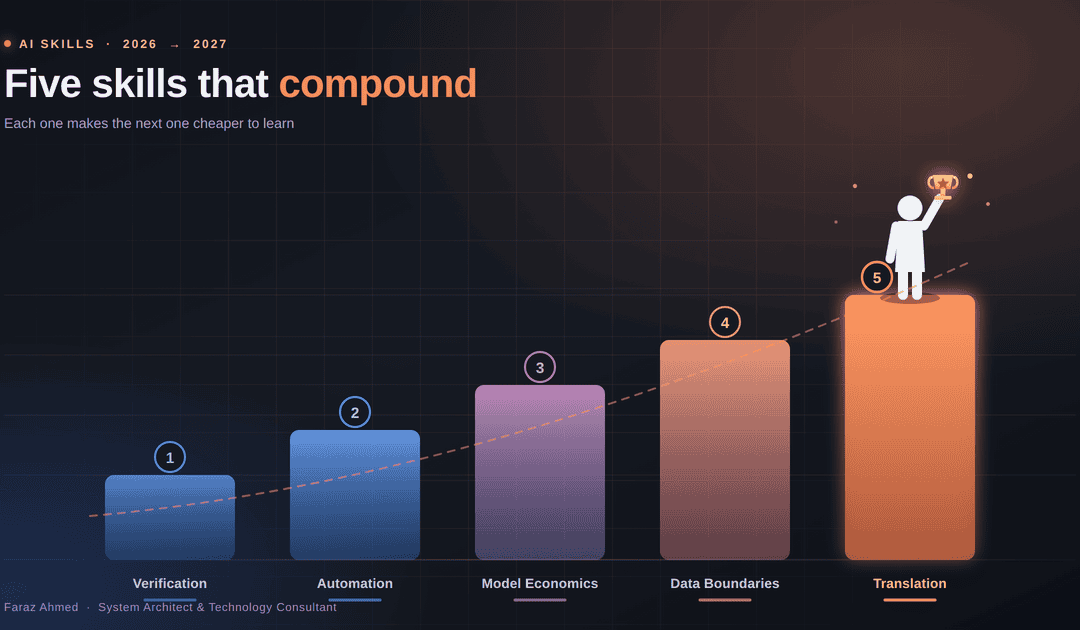
1. Verification, not "AI literacy"
The industry calls this AI literacy, which usually means understanding what a model can do and where it invents things. It is a fair starting point and a poor thing to hire on, because it describes an attitude rather than a habit.
The habit is proof.
Earlier this year a customer told me that a paid feature was ignoring the usage limits we had configured. I opened the admin panel and the limits were there. I opened the database and they were there, stored correctly, attached to the right plan. Everything looked fine.
Two separate faults were hiding behind that.
The first was junk data. Old migration rows had left duplicate entries in the limits table, and the admin screen was reading those instead of the real ones, so the panel displayed numbers that had no relationship to what the product would actually allow.
The second was worse. Nothing enforced the limit. No code anywhere checked the quota, so a customer could have consumed an entire month's allowance in one afternoon while the system kept serving requests without complaint.
That is the gap worth learning to see. A configured row is not enforcement. A green dashboard is not delivery. A plan is not a result.
Before you trust any output, ask what would look different if it were false, then go and look at that specific thing. Not the summary of it. The thing itself.
2. Automation, including the part after it breaks
Connecting two apps is not the skill anymore. The tools are drag and drop and they mostly work on the first attempt.
The skill is owning what happens when the workflow stops.
On the platform I mentioned above, access to a protected area is granted through small marker files that the membership system writes whenever a member logs in. Someone ran a cleanup routine to clear out stale files because it looked like housekeeping. It removed dozens of markers that were still doing real work, and every paying member who tried to open that area got redirected to a "no access" page. There was no error in any log I checked first, no alert, and no ticket for a while, because the page looked like a permission message and people assumed the problem was their own account.
Automation that nobody watches is not automation. It is damage with a delay fuse.
If you build something that runs without you, you have also taken on the job of knowing that it ran and knowing what it produced afterwards. A schedule is not monitoring. Neither is "it is set up". The only thing that counts is a record you actually look at.
3. Model economics
Most people choose a model the way they choose a browser. They use whatever feels familiar and never look at the invoice.
The gap between the cheapest usable model and the most expensive one is not a rounding error. The same job can cost a fraction of a cent or a dollar depending on where you send it, and on a large share of tasks the cheap one produces a result you cannot tell apart from the expensive one.
I route by difficulty rather than by brand. Extraction, classification, reformatting and summarising go to small, fast, inexpensive models. Judgement, drafting, and anything where a wrong answer costs real money go to a strong one. When a client needed an interface to keep behaving like one specific product, I pointed those requests at a different vendor's model entirely, because it handled the work better and cost a fraction of what the obvious choice would have.
Learn what a token is. Work out roughly what your own workload costs per hundred runs. Then practise predicting which tier a given task belongs in, because that judgement is measurable and almost nobody on your team will have it.
4. Data boundaries
There is a conference version of this skill called responsible AI, and a working version that is much smaller: knowing what leaves the building.
The risk is rarely the obvious thing. When I moved one of our endpoints onto a different model provider, the key itself was handled properly. It went into a file with 600 permissions, owned by the application user, outside the web root. Then a fortnight later I found a backup copy of the previous credential file sitting beside it at 644, readable by any account on that server, inside the public web directory. The secret was fine. The file next to it was not, and nobody had looked at that file because nobody thinks of a backup as data that needs protecting.
That is the pattern worth internalising. Every document you paste into a public chat tool becomes a copy you do not control, and so does every export, screenshot, log and backup that lands somewhere convenient.
Three tiers is enough of a policy. What may go to any public model, what may go only to a vendor with a contract and data terms, and what never leaves your own infrastructure at all, which permanently includes credentials, keys and personal records. Decide those tiers before you need them, because in the moment you are always in a hurry.
5. Translation
AI removed the junior task and left the judgement behind.
That is the shortest accurate description of what changed in hiring, and it explains most of the strange job descriptions you have read this year. PwC found that AI-exposed entry-level roles are seven times more likely to demand skills that used to be reserved for senior people, which is another way of saying the first draft is free now and the sign-off is not.
A draft a model produces is worth very little on its own. What carries value is the person who reads it, knows which parts are wrong, and can stand in front of a room and explain why the number should be trusted. A model cannot approve its own output. Somebody has to put their name on it, and that somebody is the job.
This is not the soft skill it gets filed under. It is the deliverable.
An exercise worth one evening
Pick a task you repeat every week that ends in a number you are judged on, whether that is revenue, leads, tickets closed or hours booked. Before you touch a tool, write down what last week's correct answer was.
Then have AI produce this week's version and compare it against that number rather than against how confident the writing sounds. When the two disagree, find out which one is wrong and why, because that disagreement is the entire lesson.
Finish by writing one paragraph that explains the result to somebody who was not in the room. If you can do that honestly, you have practised verification, automation and translation in a single sitting.
My take
I have watched three platform shifts in 25 years. Websites in the early 2000s, search and social in the 2010s, and now this one.
The pattern held every time. The people who did well were almost never holding the newest tool on the day it launched. They were the ones who could tell, quickly and without ego, whether the thing actually worked.
Tools will keep arriving weekly. Being able to check one will still be the rarer skill in 2027.
Source: PwC, 2026 Global AI Jobs Barometer (June 2026).